
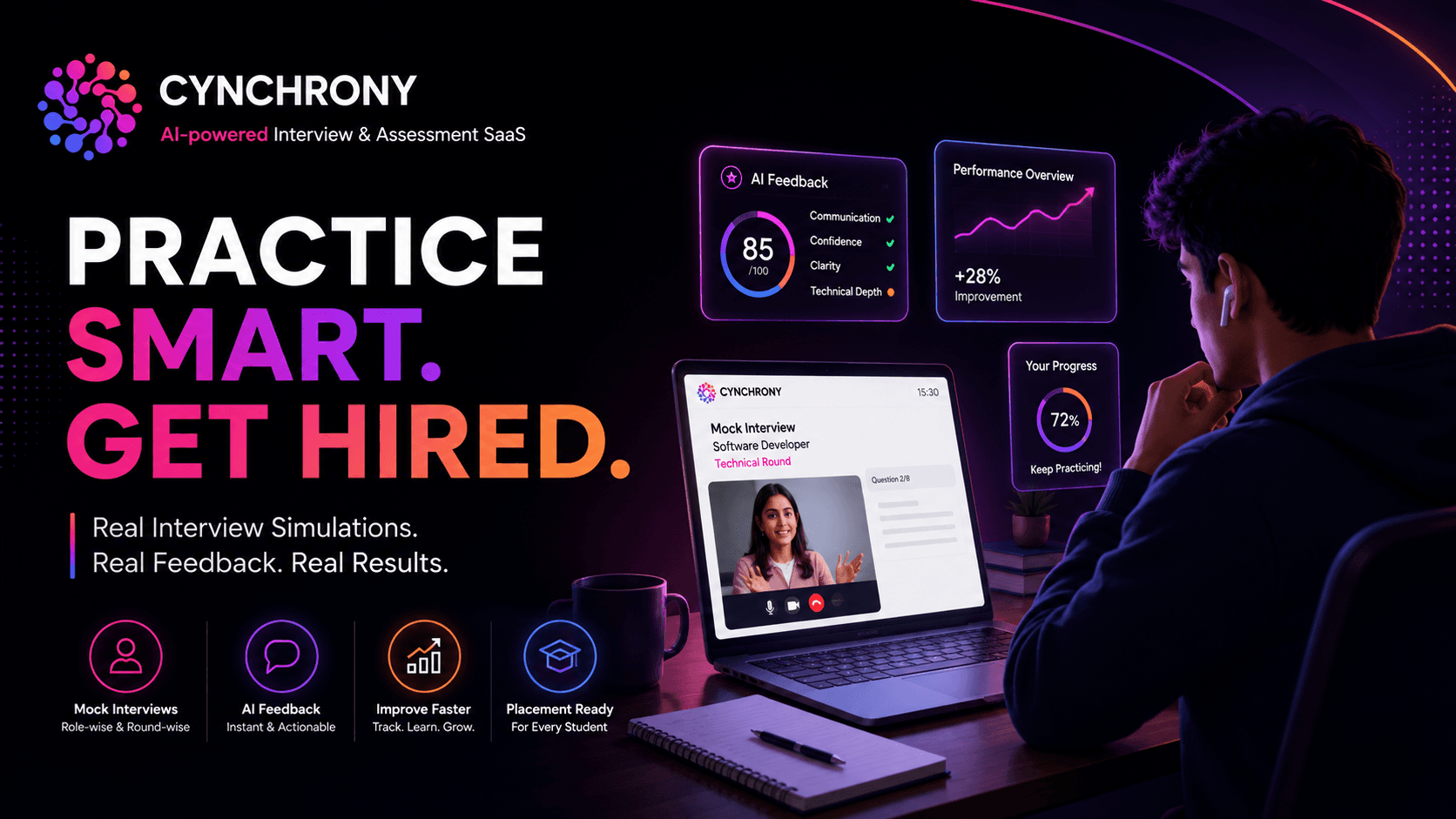
Most college placement cells run the same preparation model — a few workshops, some aptitude practice, and then placement season. This guide explains why that model consistently underperforms, what a process-driven alternative looks like, and how TPOs can improve placement rates without adding staff — through earlier prep, standardised evaluation, batch-level readiness tracking, and company-specific mock interviews.
Key takeaways
- Students fail interviews primarily because of delivery and composure failures — not knowledge gaps
- One or two pre-season workshops are not enough — interview readiness requires repeated practice over weeks
- Standardise what you evaluate so feedback is consistent and actionable across the entire batch
- Track readiness at batch level to identify intervention points before drives begin
- Company-specific preparation in the two weeks before each drive outperforms generic prep
- Batch-level platforms allow small placement teams to deliver structured practice to 500+ students
Why Students Fail Interviews (It's Not What You Think)
Ask a group of students who failed a campus drive what went wrong. Most will say: 'I didn't know the answer to one of the technical questions.' Ask the interviewers from the same drive. They say something different.
- Delivery and composure — The student knew the answer but couldn't communicate it clearly. They spoke too fast, gave a six-minute answer to a one-minute question, or went silent under follow-up pressure.
- Lack of structured responses — Unstructured answers signal poor thinking even when the underlying knowledge is sound. An interviewer cannot evaluate what they cannot follow.
- No company-specific preparation — The student prepared for 'an interview' but not for this company's interview. Different companies test different things. Students who treat all drives the same underperform on each one.
- Interview inexperience — First-time interviewees often don't know what a real interview feels like. The first real interview should not be the first one they've ever sat through.
The Problem With How Most Placement Cells Prepare Students
The standard placement preparation programme at most colleges looks like this: a few sessions on resume writing, some aptitude test practice, one or two mock interview workshops with a guest speaker, and then placement season. The problems with this model are structural.
- One or two sessions is not enough — Interview performance is a skill built through repetition and feedback over weeks — not acquired in a two-hour workshop.
- Guest speaker sessions are not scalable — A single industry expert can run ten to fifteen mock interviews in an afternoon. You have four hundred students.
- Feedback is inconsistent — Different workshops give different feedback using different criteria. Students don't know which feedback to act on.
- The timing is wrong — Most preparation happens in the two weeks before placement season. By then, the student has no time to iterate and improve.
A Process That Actually Works
A placement cell that genuinely moves its placement percentage runs a different model — one that starts earlier, runs consistently, and generates data on student readiness before the drives begin.
- Start 6–8 weeks before placement season — The students who perform best in placement drives are the ones who have been in interview conditions repeatedly — not the ones who crammed hardest the week before. Build a preparation calendar that starts in early September for October–November drives. Map it by week: aptitude and assessment practice in weeks one and two, HR round preparation in weeks three and four, company-specific and technical round practice in weeks five and six.
- Standardise the evaluation criteria — One of the least visible problems in placement preparation is inconsistent feedback. Standardise what you evaluate: communication clarity, answer structure, company and role knowledge, and follow-up handling. When all students are evaluated on the same criteria, you get data you can actually use.
- Track readiness at batch level, not just student level — The goal of tracking is not to rank students against each other. It is to identify clusters who need a specific type of support. If 60% of your batch struggles with follow-up questions but passes initial questions cleanly, that is a targeted intervention — not a general rerun of the entire programme.
- Run company-specific preparation in the two weeks before each drive — TCS interviews differently from Infosys. Infosys interviews differently from Accenture. The HR round structure, the technical depth, the follow-up style, the criteria for elimination — all of these vary. The two weeks before each drive should be dedicated to that company's interview pattern.
- Get data before the drive — If you have data showing that 40% of students are not ready for the TCS interview based on their mock performance, you can intervene before the drive begins. Without data, you are operating on intuition — and intuition doesn't move placement percentages.
How to Do This at Scale with a Small Team
The practical objection to everything above is the same: 'We have two people in the placement cell and four hundred students.' This is a real constraint. Manual delivery of the process above is not feasible at scale. Institutional platforms that handle bulk mock interview scheduling and batch-level tracking solve this. They allow students to complete practice sessions on demand without requiring a human to be present, allow placement cells to review session data by batch and round, and allow company-specific content to be assigned to specific student cohorts. The trainer and TPO don't disappear from the process — they focus their time on the students who need direct intervention, not on running sessions for students who can self-practice effectively. Cynchrony's institutional platform was built for exactly this use case: bulk mock interviews, assessment practice, and batch-level readiness tracking — managed through a dashboard built for TPOs and trainers. Currently deployed at universities and NSDC training centres across India. Book a demo → https://www.cynchrony.in/for-institutions
What to Stop Doing
Three practices that consistently underperform and should be retired from the standard placement prep model.
- Stop measuring preparation by sessions delivered — Measure by student readiness. A batch that has completed twenty sessions with no feedback iteration has not prepared — it has repeated.
- Stop running placement prep only for students who ask for it — The students who ask for extra preparation are usually not the ones who need it most. Build a programme that reaches the entire batch.
- Stop waiting for results to understand what went wrong — By the time you know that 30% of your batch didn't clear the HR round, placement season is over. Get the data during practice, not after the drive.
What Good Looks Like
A placement cell running a structured, data-driven programme produces a different outcome from one running a standard workshop series.
- Students walk into drives having already experienced the format, pressure, and follow-up structure of that company's interview
- The placement team knows, before the drive, which students are likely to struggle and has already intervened
- Feedback is consistent across the batch — every student was evaluated on the same criteria
- Company-specific preparation runs two weeks before each drive, not just before placement season as a whole
- Post-drive data feeds back into the next round of preparation
Frequently Asked Questions
- What is the most important factor in improving college placement rates? — Structured, repeated interview practice — not more content sessions. Most students who fail campus drives don't fail because they don't know the subject. They fail because they can't perform under interview conditions. Practice in those conditions, with feedback, before the drive is what changes the outcome.
- How many mock interviews should a student complete before placement season? — A minimum of three to five full sessions across HR and technical rounds, spaced over four to six weeks. One session the week before placement season is not preparation — it is exposure.
- How do we run mock interviews for 500 students with a small placement team? — Manual delivery at that scale is not feasible. Platforms designed for batch-level mock interview management allow students to practice on demand while the placement team monitors readiness data and focuses intervention where it's needed.
- Does NAAC assess placement rate data? — Yes. Student placement outcomes are part of NAAC accreditation evaluation under student support and progression metrics. Structured preparation programmes and the data they generate can support institutional documentation.
- When should placement preparation start? — Six to eight weeks before the first drive of the placement season. For most colleges, this means starting in early September for October–November drives. Programmes that begin two weeks before the season consistently underperform programmes that start six weeks earlier.
Action items
- 1Map out your placement season calendar and identify the 6-week window before the first drive
- 2Define three to four evaluation criteria you will standardise across all mock interview sessions
- 3Identify which student cohorts are at highest risk based on current academic and aptitude data
- 4Book a demo with Cynchrony to see the institutional dashboard in action: cynchrony.in/for-institutions
Conclusion
The placement percentage doesn't improve because students suddenly know more. It improves because students who already knew enough can now demonstrate that in an interview. The difference between placement cells that move their numbers and those that don't is almost never resources. It is process — earlier, more consistent, more data-driven preparation that puts students in interview conditions before the first drive of the season. If you want to see how Cynchrony helps institutions run bulk mock interviews and track batch-level readiness, book a demo at cynchrony.in/for-institutions.
Ready to practise?
Learn more