
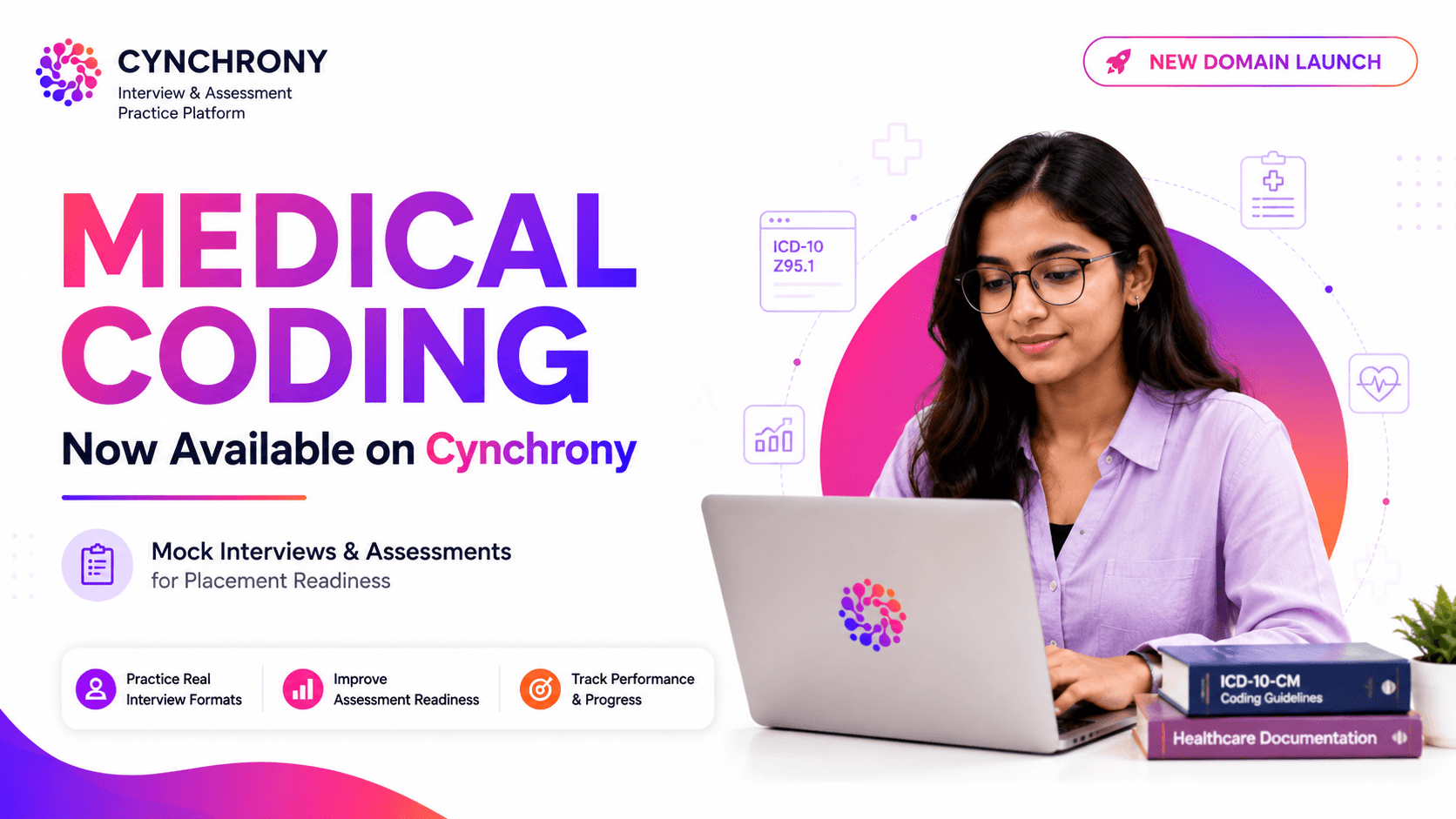
Medical Coding and Healthcare RCM is now a supported domain on Cynchrony, giving training institutes and allied health colleges a way to run assessments and mock interviews for this field and track batch-level readiness through the Management and Trainer dashboards. This post covers why this domain matters for placement outcomes, where training programs typically lose visibility, and what institutions can now measure.
Key takeaways
- Medical Coding and Healthcare RCM is now a supported assessment and mock interview domain on Cynchrony
- Course completion and placement readiness are different things — institutions need a way to measure the second one specifically
- Healthcare RCM hiring demand in India has been consistent; placement conversion depends more on readiness than curriculum
- Medical Coding assessments and mock interviews connect to the existing Management and Trainer dashboards for batch-level tracking
- Running a baseline readiness check before placement season gives institutions time to act on what the data shows
The Gap Between Course Completion and Placement Readiness
Most medical coding training programs are structured around the same core curriculum — ICD codes, coding guidelines, classification logic, and documentation standards. Institutes have largely mastered delivering this content, and internal assessments reflect that. But placement-stage evaluation looks at a different set of things entirely — and training data alone doesn't predict performance on these.
- Course completion rates and internal test scores measure exposure to content, not performance under evaluation conditions
- Placement-stage assessments and interviews introduce time pressure, follow-up questions, and scenario-based reasoning that internal tests rarely replicate
- Without a way to test for this gap before placement season, institutions only discover it when results come in
Why This Matters for Medical Coding Specifically
Healthcare Revenue Cycle Management is one of India's largest healthcare outsourcing sectors, with consistent hiring tied to insurance claims processing, clinical documentation, and compliance work for global healthcare systems. For Life Sciences, Pharmacy, Nursing, and Allied Health graduates, medical coding remains one of the more accessible entry points into this sector. The demand side is stable. What varies, batch to batch and institute to institute, is how many trained students convert into placements — and that variance is rarely explained by curriculum quality alone.
- Hiring demand for certified medical coders has remained consistent, driven by ongoing healthcare RCM outsourcing
- Placement conversion rates vary more by readiness than by training content
- Institutions that can identify readiness gaps early have more time to address them before drives begin
What's Now Available for Medical Coding Batches
With Medical Coding added as a supported domain, institutions can run structured assessments and mock interviews built specifically for medical coding and healthcare RCM — not generic aptitude or technical content repurposed for the domain.
- Medical coding and RCM-specific assessments, covering topics and scenario-based questions relevant to the field
- Mock interviews structured around HR, technical, and domain-specific questions for medical coding roles
- Structured feedback per student, showing where performance is strong and where it needs work — not just a pass or fail outcome
Batch-Level Visibility Through Existing Dashboards
Medical Coding connects to the same Management and Trainer dashboards already used across other domains on Cynchrony — so institutions running multiple programs don't need a separate system for this cohort.
- Management Dashboard: run assessments and mock interviews across an entire medical coding batch, and view readiness at batch level
- Trainer Dashboard: individual trainers can review student performance, conduct evaluations, and track progress per student
- Standardised evaluation criteria across trainers, reducing the inconsistency that comes from different trainers grading differently
- Readiness data available weeks before placement drives begin, not discovered during them
What to Do With This Before the Next Placement Cycle
For institutions currently running or planning medical coding batches, the practical next step is to run a baseline assessment and mock interview cycle for the current batch — before placement drives are scheduled.
- Run a baseline medical coding assessment across the batch to establish a readiness snapshot
- Run mock interviews for medical coding roles to identify students who need additional interview practice
- Use the Management Dashboard to identify at-risk students with enough lead time to provide targeted support
- Repeat closer to placement season to measure improvement and confirm readiness before drives begin
Action items
- 1Run a baseline medical coding assessment and mock interview cycle for your current batch
- 2Use the Management Dashboard to identify students who need additional interview practice before placement drives
- 3Standardise medical coding evaluation across trainers using shared assessment criteria
- 4Visit www.cynchrony.in/for-institutions to set up Medical Coding assessments for your institution
Conclusion
Healthcare RCM hiring in India has been consistent for years, and medical coding remains one of the more accessible entry points for Life Sciences, Pharmacy, Nursing, and Allied Health graduates. The demand for placement-ready candidates isn't the constraint. What institutions have lacked is a way to see, at batch level, who is actually ready for a medical coding interview and assessment — not just who completed the course. Medical Coding assessments and mock interviews are now available on Cynchrony, connected to the same Management and Trainer dashboards used across other domains. See how batch-level readiness tracking works for your medical coding cohort at www.cynchrony.in/for-institutions
Ready to practise?
Book a demo