
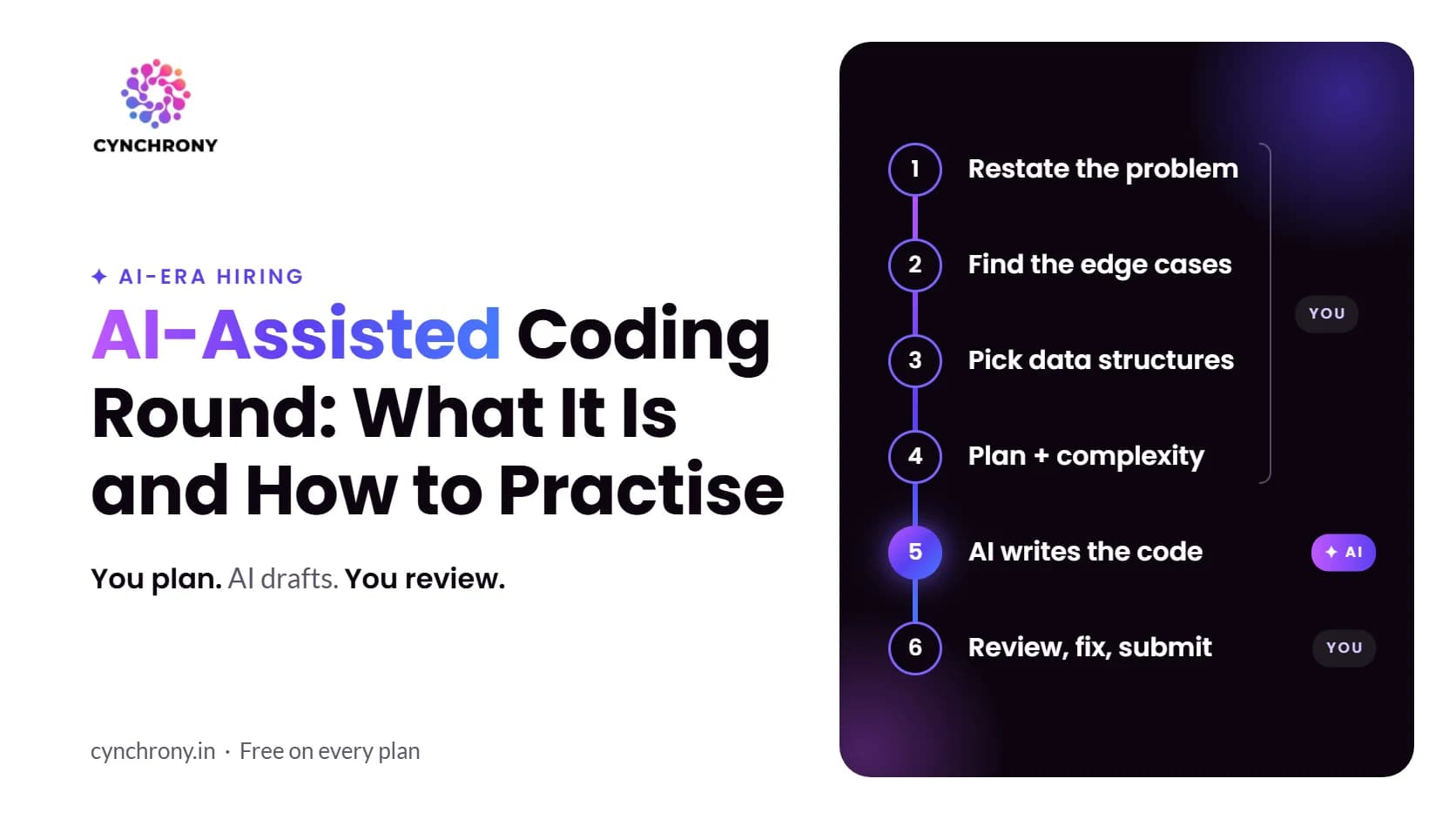
An AI-assisted coding round is a coding round where you solve the problem with an AI assistant. You restate the problem, list edge cases, choose data structures and plan the approach; the AI drafts code from your plan; then you review, fix and submit it. You are judged on your thinking and your review, not your typing speed.
Key takeaways
- An AI-assisted coding round lets you use an AI assistant, but grades your thinking and your review
- Some companies, such as Canva, now expect AI use in technical interviews; most Indian campus rounds still do not allow it
- Restate the problem, list edge cases, choose data structures with a reason and plan with complexity before the AI writes code
- Treat AI code as a draft: test it against your edge cases and fix what breaks
- Fundamentals still matter; they are how you give the AI a good plan and spot a bad answer
- The same habits score well in coding rounds with or without AI
What is an AI-assisted coding round?
An AI-assisted coding round is a coding problem you solve together with an AI assistant, usually a chat panel beside the code editor. The assistant can write and explain code, but the round is designed so that the quality of the result depends on you. In a traditional round, the interviewer mostly sees your final code. In an AI-assisted round, they see your whole process: how you described the problem to the AI, what you asked it to do, whether you accepted its output blindly, and how you found and fixed its mistakes. The format varies. Some companies give you a small existing codebase and ask you to fix a bug or add a feature with AI help. Practice platforms, including Cynchrony, use a staged format where you must explain and plan before the AI writes anything. Both test the same core skill: directing an AI and verifying its work.
- What stays the same: you still need to understand data structures, complexity and edge cases
- What changes: less credit for typing a memorised solution, more credit for planning and review
- What you are: the person responsible for whether the final code is correct
Why are companies adding AI to coding rounds?
Developers now use AI coding tools at work, so some companies want their interviews to test the job as it is actually done. One of the clearest public examples is Canva. On 11 June 2025, its engineering blog announced that candidates for backend, frontend and machine learning engineering roles are expected to use AI tools such as Copilot, Cursor or Claude in technical interviews, and that an AI-assisted coding round would replace its computer science fundamentals screen for backend and frontend roles in a pilot. Canva's post says it looks at when and how well candidates use AI, how they break down unclear requirements, whether they make sound technical decisions, and whether they can find and fix problems in AI-generated code. None of that is about typing speed. This does not mean every company allows AI. Most service-company assessments and campus drives in India still expect you to code without it. Treat AI-assisted rounds as a growing format to be ready for, and check each company's own instructions before your round.
How does an AI-assisted coding round work, step by step?
Formats differ between companies, but a well-run round follows the same order a good engineer would. On Cynchrony, the round is built as six steps, and the AI only opens up once you have shown your thinking.
- Restate the problem in your own words, as you would say it to an interviewer; if your summary misses something important, you are asked about it before moving on
- List the inputs, outputs and edge cases: empty input, a single element, duplicates, negative numbers, very large values
- Choose the data structures and say why: 'because I need constant-time lookups by key' is a reason, 'because it is fast' is not
- Plan the approach in plain steps and state its time and space complexity; this is the plan the AI will work from
- Generate the code with AI from your plan, not from the problem statement, so a gap in your plan becomes a gap in the code
- Review, refine and submit: read the code, run it, test the edge cases from step 2, fix what is wrong and submit
What does a strong AI-assisted round look like?
Here is a worked example on a common practice problem: given a string, return the index of the first character that does not repeat, or -1 if there is none. Read it for the structure; the same shape works on any problem. Restate: 'I need to scan the string and find the first position whose character appears exactly once. If every character repeats, I return -1. Should uppercase and lowercase count as different characters?' Edge cases: an empty string returns -1; a single character returns 0; a string where everything repeats, like "aabb", returns -1; spaces count as characters unless told otherwise. Data structure: a hash map from character to count, because I need constant-time lookups while I scan. Plan: first pass, count every character; second pass, return the first index whose count is 1; if the loop ends, return -1. That is O(n) time and O(k) extra space, where k is the number of distinct characters. Review: suppose the AI's draft counts correctly but ends with 'return 0' after the loop. On "aabb" it would return 0, which looks like a valid index, so the bug is easy to miss. Testing the all-repeating case from the edge-case list catches it, and the fix is one line: return -1.
- Why it works: the restatement ends with a question, so a wrong assumption is caught before any code exists
- Why it works: the edge cases are written down early and reused as test cases during review
- Why it works: the data structure comes with a reason tied to the problem
- Why it works: the plan states complexity, so the AI's code can be checked against it
- Why it works: the review tests the case most likely to break, instead of only the happy path
How is an AI-assisted coding round scored?
Companies publish few scoring details, so be wary of anyone claiming an exact rubric. Public descriptions agree that the process counts, not just the output. On Cynchrony, each round runs 20 to 45 minutes and is graded with a scorecard when you submit. Use it to find the step that is costing you: many students discover their code is fine but their restatement is thin, or that they plan well and then accept generated code without testing it.
- Problem understanding: did you restate the problem accurately and ask about what was unclear?
- Edge cases: did you find the inputs that break careless code before writing any?
- Decisions: can you justify your data structures and complexity?
- Direction: were your instructions to the AI clear, specific and based on your plan?
- Verification: did you test, read and fix the AI's code rather than trust it?
What mistakes cost freshers marks in this round?
Most weak rounds come from treating the AI as an answer machine instead of a helper you supervise.
- Pasting the whole problem into the AI and accepting the first answer
- Skipping the restatement and edge cases because 'the AI will handle it'
- Asking for code before you have a plan, then being unable to explain what it does
- Running the code once on the sample input and calling it done
- Fixing a bug by asking the AI to 'fix it' repeatedly, without understanding the cause
- Never stating time and space complexity
How should freshers prepare for an AI-assisted coding round?
Prepare the thinking first, because that is what the round grades. You still need solid fundamentals: arrays, strings, hashing, two pointers, stacks, trees, basic SQL and debugging. AI does not remove the need to know when each one applies; it makes that judgement more visible. Then practise the full workflow out loud, timed, in the language you will use on the day. Python, Java, C++, C and JavaScript are the common choices; pick one and stay with it. If you want a deeper guide to the talking part, read our post on how to explain your approach in a coding interview. Practise an AI-assisted coding round on Cynchrony: free on every plan.
- Week 1: for every problem, write the restatement, edge cases, data structure with a reason and a plan with complexity before any code
- Week 1: practise reading code you did not write; take a working solution, break one line, and find the bug by testing
- Week 2: run timed rounds of 30 to 45 minutes where you plan first and only then use AI or write code
- Week 2: after each round, list the edge cases you missed and the step that took longest, and fix that step next time
- Before any real round: confirm with the company whether AI tools are allowed, and which ones
Frequently Asked Questions
- Do Indian campus coding rounds allow AI tools? — Most campus and service-company coding assessments still expect you to code without AI. Some companies, mostly for experienced or product roles, have started allowing it, so always check the instructions for each round.
- Is an AI-assisted coding round easier than a normal coding round? — Not really. The AI saves typing, but you are judged more on understanding, planning and catching mistakes, and AI code can contain bugs that are easy to miss.
- Do I still need to learn data structures and algorithms? — Yes. You need them to choose an approach, give the AI a good plan and judge whether its code is correct and efficient.
- Which programming language should I use? — The one you will use in your real interview. On Cynchrony you can practise in Python, Java, C++, C or JavaScript.
- Is AI-assisted coding practice free on Cynchrony? — Yes. It is included in every plan, including Free, and does not use interview credits. You need an account: it is free to start, and you sign up with email.
Action items
- 1Write a five-line plan (restatement, edge cases, data structure, steps, complexity) before coding your next ten practice problems
- 2Practise finding bugs in code you did not write, testing edge cases first
- 3Check whether each company on your list allows AI tools in its coding round
- 4Practise an AI-assisted coding round on Cynchrony, free on every plan, in the language you will use on the day
Conclusion
AI-assisted coding rounds do not reward the fastest typist. They reward the candidate who understands the problem, plans clearly, and refuses to submit code they have not checked. Those habits help in every coding round, with or without AI. Start building them today with an AI-assisted coding round on Cynchrony. It is free on every plan; sign up with email.
Ready to practise?
Practise an AI-assisted coding round free