
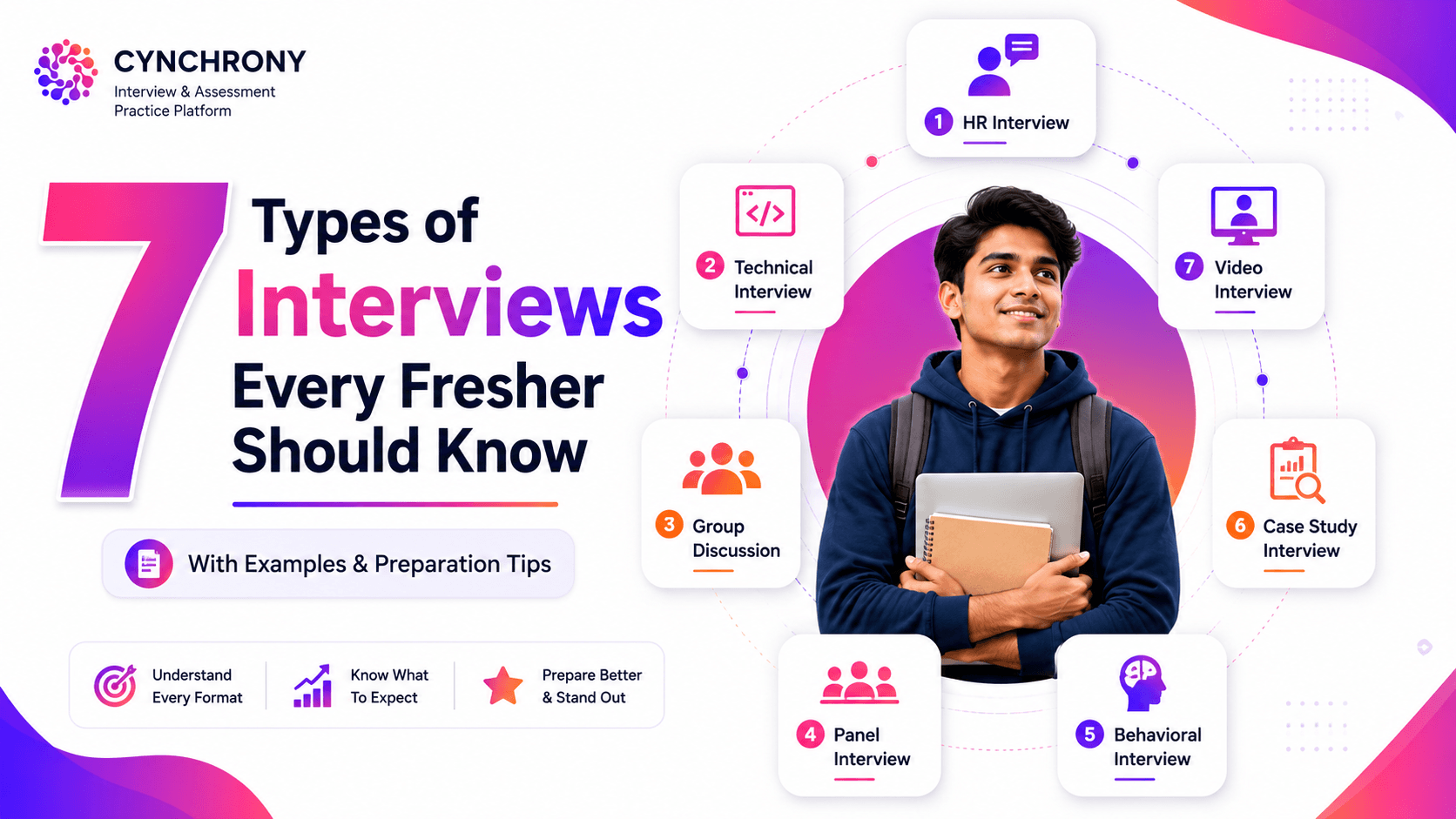
Not all interviews are the same format, and not all interview types appear in every hiring process. This guide covers the seven types of interviews freshers are most likely to encounter — what each one tests, what to expect, and how to prepare for it.
Key takeaways
- There are seven main interview types: HR, technical, managerial, group discussion, case study, panel, and stress
- Each type tests different dimensions: communication, knowledge, judgment, teamwork, analysis, composure
- Most campus placement drives use two to three types — typically HR and technical, with managerial for shortlisted candidates
- Prepare specifically for the types used by your target companies, not for all seven equally
- The HR round is the most common and the most coachable — it rewards structured practice more than any other type
1. HR Round — The Most Common Campus Interview
The HR round is the most common interview type in Indian campus placements. It appears in almost every drive, often as the first or final filter in the process. What it tests: Your communication, personality, self-awareness, cultural fit, and ability to present yourself clearly. The HR round is not a test of technical knowledge — it is a test of whether you can articulate who you are, why you want the role, and how you respond to pressure.
- Common questions: Tell me about yourself, why this company, where do you see yourself in five years, what are your strengths and weaknesses
- What you need to demonstrate: Clarity, structure, self-awareness, and composure
- How to prepare: Practice your answers out loud, not just in your head. The difference between knowing an answer and being able to deliver it clearly under interview conditions is significant.
2. Technical Interview — Knowledge Under Pressure
The technical interview tests your domain knowledge — programming, core engineering subjects, or role-specific skills — under the pressure of a real conversation. Unlike a written test, the technical interview requires you to explain your thinking, not just produce the right answer. What it tests: Depth of technical knowledge, ability to think through problems out loud, and how you handle a question you don't immediately know the answer to.
- Common areas: Programming languages, data structures and algorithms, DBMS, operating systems, OOPS, and role-specific tools
- What you need to demonstrate: Structured problem-solving, honest acknowledgement of what you don't know, and the ability to reason through unfamiliar problems
- How to prepare: Practice explaining your answers out loud — not just writing code or solving problems silently. Being able to articulate your reasoning is as important as reaching the right answer.
3. Managerial Round — Situational and Behavioural Questions
The managerial round is conducted by a senior manager or department head and focuses on how you handle real situations — conflict, ambiguity, pressure, and teamwork. It appears in companies that want to assess cultural and functional fit beyond technical and HR dimensions. What it tests: Judgment, leadership potential, how you approach conflict and ambiguity, and how you work within a team.
- Common questions: Describe a situation where you led a team under pressure, how have you handled a disagreement with a teammate, what would you do if given a task you were not qualified for
- What you need to demonstrate: Structured thinking, self-awareness, and the ability to give specific examples rather than vague generalisations
- How to prepare: Use the STAR method (Situation, Task, Action, Result) for every behavioural question. Prepare three to four strong examples from projects, college work, or extracurriculars that you can adapt to different questions.
4. Group Discussion — Assessed Alongside Peers
In a group discussion, you are evaluated alongside five to ten other candidates on a given topic. It is less common than it was a decade ago but still appears in certain companies and management institutes. What it tests: Communication, ability to listen and build on others' points, leadership without aggression, and how you perform in a group setting.
- Common formats: Topic-based discussion, case-based discussion, abstract topics
- What you need to demonstrate: You do not need to speak the most — you need to make the strongest contributions. Quality over quantity. Listening and building on others' points scores as well as introducing new ones.
- How to prepare: Practice with a group of peers using real GD topics. Read about current events, business issues, and social topics so you can contribute facts, not just opinions.
5. Case Study Interview — Problem-Solving in Real Time
Case study interviews are most common in consulting, management, and business analyst roles. The interviewer presents a business problem and evaluates how you structure and work through it. What it tests: Analytical thinking, structured problem decomposition, how you handle incomplete information, and how you communicate your reasoning.
- Common in: Consulting (Deloitte, McKinsey, BCG), business analyst roles, MBA campus placements
- What you need to demonstrate: A structured framework for breaking down the problem, the ability to make assumptions explicitly rather than implicitly, and a clear recommendation at the end
- How to prepare: Practice case frameworks (profitability, market entry, operations) and work through sample cases out loud. The answer matters less than how you approach it.
6. Panel Interview — Multiple Interviewers at Once
A panel interview involves two or more interviewers conducting the session simultaneously. This format is used by companies that want multiple perspectives on a candidate in a single session. What it tests: How you handle being evaluated by multiple people at once, your ability to direct answers to the right person, and how composed you remain under more intense observation.
- Common in: Government recruitment, senior roles, certain MNC campus drives
- What you need to demonstrate: Maintain eye contact with the person who asked the question, briefly acknowledge others. Do not give your entire answer to one person and ignore the rest.
- How to prepare: Practice maintaining composure when multiple people are watching you answer. A mock interview with two or three observers is good preparation for this format.
7. Stress Interview — Designed to Test Composure
A stress interview is deliberately confrontational — the interviewer may challenge your answers, dismiss your reasoning, or ask unusually aggressive follow-up questions. The goal is not to catch you out on facts but to see how you respond under pressure. What it tests: Emotional composure, how you handle criticism or aggression without becoming defensive or rattled, and whether you can maintain clarity of thought when pushed. Stress interviews are not common in standard campus placement drives but may appear in customer-facing or high-pressure roles.
- Common signals: The interviewer challenges a statement you made, dismisses an answer and asks again, or asks rapid successive questions without waiting for full answers
- What you need to demonstrate: Stay calm. Take a breath. Acknowledge the challenge directly and explain your reasoning calmly. Defensiveness and rattled responses are exactly what the format is testing for.
- How to prepare: Practice handling pushback on your answers in mock interview sessions. Ask a practice partner to challenge your responses deliberately.
Frequently Asked Questions
- Which type of interview is hardest for freshers? — For most freshers, the technical interview is the most preparation-intensive. The HR round causes the most anxiety because of its open-ended nature — but it is also the most coachable with practice.
- Do all companies use all seven interview types? — No. Most campus placement drives use two to three types — typically HR round plus technical, with a managerial round for final-stage candidates. Group discussions and case study interviews appear in specific company and role contexts.
- How do I know which interview types my target company uses? — Research the company's hiring process before applying. Platforms that track real interview experiences from past candidates are useful. Seniors who went through the same company's drive are an even better source.
- Can I prepare for all seven interview types before placement season? — Yes, but prioritise based on your target companies. If you are focusing on mass recruiters like TCS and Infosys, invest heavily in HR and technical round preparation. If you are targeting consulting roles, add case study preparation.
Action items
- 1Research which interview types your target companies use before starting preparation
- 2Prioritise HR and technical round preparation for mass campus recruiters
- 3Use the STAR method for all managerial and behavioural questions
- 4Visit www.cynchrony.in to practice specific round types with AI-driven feedback
Conclusion
Most campus placement drives involve two to four of these interview types. The most common combination is HR round followed by a technical round, with a managerial round for shortlisted candidates. Knowing which types your target companies use — and practicing specifically for those — is more effective than generic interview preparation. For round-specific mock interview practice, visit www.cynchrony.in
Ready to practise?
Practise 7 Rounds here