
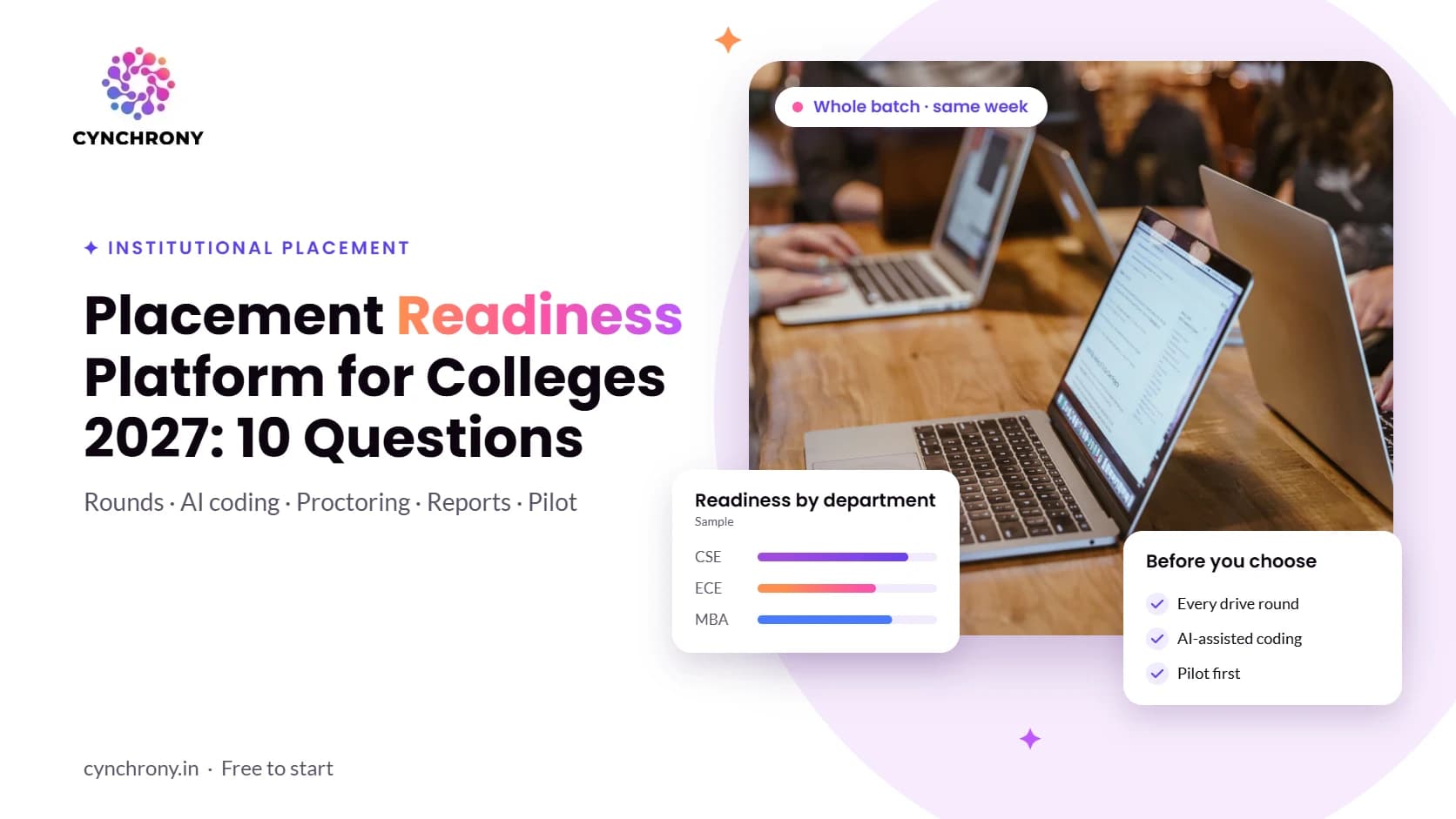
Before choosing a placement readiness platform for colleges, ask ten questions: does it cover every round, can the whole batch practise at once, how is each round scored, does it cover AI-assisted coding, can you build your own rounds, are attempts recorded and proctored, what reports you get, who sees student data, and how a pilot works.
Key takeaways
- A readiness platform prepares students for the drive; placement management software runs the drive
- Check coverage of every round, not just HR interviews
- Ask how AI-assisted coding is handled, and what it grades
- Your own rounds, recordings and proctoring make scores usable for decisions
- Department and batch reports are the reason a placement cell buys a platform
- Pilot with one department before committing the whole campus
Does it cover every round of a campus drive?
A campus drive is a sequence of rounds, and a student who is strong in one can still be eliminated in another. A platform that covers only HR interviews leaves the aptitude test and the coding round to chance.
| Question | What a good answer covers |
|---|---|
| 1. Which rounds can students practise? | Aptitude and reasoning tests, technical and HR interviews, coding rounds, and for MBA and BBA batches, conversations such as sales or customer service |
| 2. Can the whole batch practise at the same time? | Students practise from their own phones or laptops in a window you set, without booking rooms or panel slots |
| 3. How is each round scored? | A scorecard after every attempt, on the same criteria for every student, with feedback the student can act on |
Does it prepare students for AI-assisted coding rounds?
Some employers now allow or expect AI tools in technical interviews. Canva's engineering blog announced in June 2025 that it expects candidates to use AI tools in its technical interviews. Most campus tests in India still do not allow AI, but CS and IT batches graduating in 2027 may meet both formats. A platform that prepares students only for timed, from-memory coding misses the newer format; one that lets the AI do everything teaches the wrong habit. Ask how the platform handles both.
- 4. Does it have an AI-assisted coding round, and what does it grade? | The student restates the problem, plans the approach and reviews AI-written code, and is graded on that thinking, not only on whether the code runs
- Ask which languages are supported, and whether SQL and debugging problems are included, since both appear in fresher tests
Can your team build its own rounds?
The companies that visit your campus are not the same as the ones that visit a college in another state. A fixed question bank cannot follow your recruiter list.
- 5. Can the placement cell create its own rounds and question sets? | Your team sets the role, the company focus and the round type, and can change them each season
- Ask how long it takes your staff to set up one new round, and whether faculty can do it without the vendor
Can you trust how a score was earned?
A readiness score is only useful if the team believes it. Practice attempts can stay open, but a round you use to decide who goes forward needs controls.
- 6. Can each round be recorded and proctored, and who decides? | The college chooses per round; a recorded attempt shows how the student actually answered; proctoring flags tab switches, other people or phones for review
- Ask what the student sees before a recorded attempt starts, such as a camera and microphone check, and how flagged moments are shown to your team
What will the placement cell actually see?
The point of a platform for a placement cell is the batch-wide view: who practised, how each department is doing, and which gaps keep recurring, early enough to act before the drive.
- 7. What reports come out of it? | Results by student, department, year and batch; who has not practised; the skill gaps that recur across the cohort; figures you can share with the principal and heads of department
- 8. Who can see student data, and what is it used for? | Only your authorised staff see your students' results; data is used to run practice and produce your reports; faculty mentors see only the students assigned to them
How does a pilot work, and what does it cost the team?
No college should commit the whole campus to a platform it has not seen with its own students. A pilot with one department or section answers the questions a demo cannot.
- 9. Can you run a pilot with one batch first? | A fixed window with one department or section, with a readiness report at the end that you can compare with your own judgement
- 10. How much staff time does it take each week? | Setup, reminders and review should take hours, not days; ask for the vendor's onboarding steps and who on their side supports you
- Ask for the pricing model in writing (per student, per batch or per module) before the pilot ends, so the comparison is fair
How should you score vendors against each other?
Put the ten questions in a sheet, one column per vendor, and fill it from what you saw on a live account, not from brochures. A simple scale keeps the comparison honest. Score | Meaning
- 2 | Shown working on a live account during the demo or pilot
- 1 | Described in writing, but not shown
- 0 | Not offered, or the answer was vague
- Weight questions 1, 2, 7 and 9 higher if your main goal is getting the whole final-year batch to practise before the next drive
Where does Cynchrony stand on these questions?
Cynchrony is our product, so read this as our own answers, to check against a demo. As described on our Universities and Colleges page: the placement cell assigns AI mock interviews (HR, technical, managerial and domain), online assessments, AI-assisted coding rounds in Python, Java, C++, C and JavaScript, and Role Play conversations to the batch; students practise from their own devices; your team can build its own rounds and choose per round whether attempts are recorded and proctored; and the readiness report shows results by student, department, year and batch. Many colleges start with a pilot in one department or section. Book a demo to see it on a live account.
Frequently Asked Questions
What is a placement readiness platform?
Software that lets students practise the rounds of a campus drive, such as aptitude tests, interviews and coding rounds, and shows the placement cell who is ready. It is different from placement management software, which runs drive logistics like registrations and offers.
What should a college ask before choosing a placement readiness platform?
Whether it covers every round, lets the whole batch practise at once, scores every attempt consistently, covers AI-assisted coding, lets you build your own rounds, records and proctors attempts, reports by department and batch, protects student data, and offers a pilot.
Should a college run a pilot first?
Yes. A pilot with one department or section shows how many students actually practise, what the report looks like for your own students and how much staff time it takes.
Do AI mock interviews replace faculty panels?
No. Panels with faculty and alumni are still valuable. A platform gives every student repeated practice first, so panel time goes to the students who need it most.
Why does AI-assisted coding matter for a placement platform?
Some employers now allow AI tools in technical interviews, while most campus tests still do not. A platform for CS and IT batches should prepare students to plan, explain and review code either way.
Action items
- 1Copy the ten questions into a sheet with one column per vendor
- 2Ask every vendor to show each answer on a live account, and score 2, 1 or 0
- 3Run a pilot with one department or section before the next campus drive
- 4Book a Cynchrony demo and score it on the same sheet
Conclusion
The right platform is the one your students actually use and your team actually reads. Ask the same ten questions of every vendor, insist on seeing answers on a live account, and pilot before you commit. Book a demo to put Cynchrony through the same checklist. Sources: Cynchrony Universities and Colleges page (cynchrony.in/solutions/universities-and-colleges), checked 27 November 2026; Canva engineering blog, 'Yes, you can use AI in our interviews' (canva.dev, 11 June 2025).
Ready to practise?
Book a demo for your placement cell